|
Home ||
DreamMaster ||
Word Art ||
Astro-Dating.com ||
Astro-Grid.com ||
Music ||
Instant Enlightenment ||
Psychic Party Games ||
Telekinesis Visual Telepathy || Art Gallery || Poetry || Fiction || Inventions || Videos || Photos || Physical Products || In The Works || Donate || Contact |
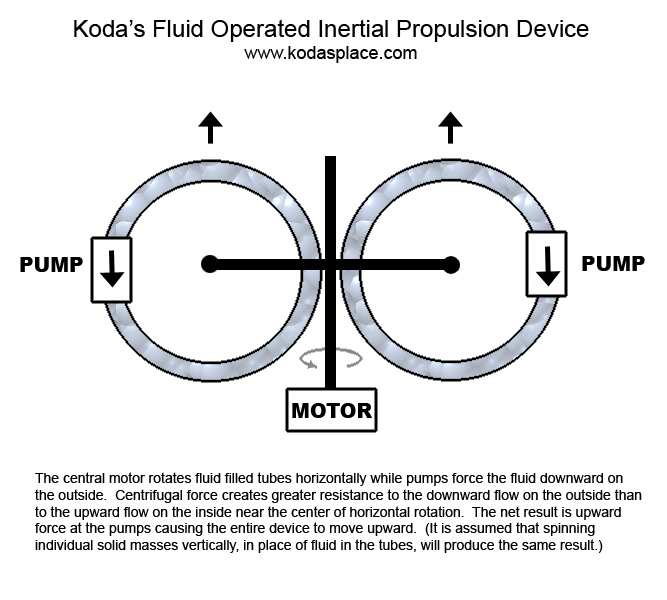
| I have decided to publish the "secret" to inertial propulsion that I have been keeping to myself for decades simply because I am still too poor to build a test unit and would prefer to give the invention away anyway. It would be nice not to be poor though. Oh well :) The drawing above should make the info clear to those who understand the concept of inertial propulsion. For everyone else I offer the following explanation. |
|
It's not really anti-gravity, but when I tell people I'm working on inertial propulsion their
faces respond with a blank stare. If such a device can ever be made to work it will replace rocket
motors with something so cheap and simple that backyard mechanics could build spacecraft in their
garages at home. It's not anti-gravity, but it produces similar effects. In simplified terms, inertia is the stuff you put into a ball when you throw it into the air. (The input of kinetic energy produces momentum, which has inertia.) The more inertia you put into the ball (the harder you throw it) the higher it will go. When the inertia runs out (from the resistance of gravity) the ball falls back to the ground. Isaac Newton, the father of modern science, described inertia something like this: "an object in motion will remain in motion unless acted upon by an outside force." In this case that outside force is gravity. Let's start by making an observation. If you swing a bucket of water rapidly around you on the end of a rope, you can swing the bucket up side-down over your head and the water won't fall out. Gravity seems to have no effect on the water. That's because inertia makes the water want to keep moving the same direction it had been moving previously - away from the center of rotation. The water gets pressed against the bottom of the bucket. Inertia moving in a circular pattern like this is called centrifugal force. But if you were to suddenly let go of the rope the inertia would make the bucket of water go flying off through the air in one direction - till gravity overcame the inertia and the bucket came crashing to the ground. The concept of inertial propulsion involves building a device which continuously adds inertia in only one direction. It would be like having a baseball with a motor and other parts inside it that keeps pushing the ball after you throw it. The ball would go upward higher and higher, far beyond the planet into outer space, till the motor ran out of fuel. If inertial propulsion can be achieved, it would be possible to build a machine that could fly through the air, into outer space, even travel underwater -- all with the same machine. And since any kind of motor could be used to generate the inertia it would be possible for modified VW bugs to fly to the moon, though of course that would require A LOT of modification. :) But mainstream science doesn't believe inertial propulsion is possible. That's because Newton came up with another observation, "every action has an equal and opposite reaction." The constant creation of inertia in one direction could propel a spacecraft, but that thing about equal and opposite reactions seems to make inertial propulsion impossible. If you push something in one direction, you end up pushing something else in the opposite direction. When you try to make something go up, something else has to go down. The net motion is zero. Imagine an astronaut floating in space. If he throws a baseball in one direction his whole body moves a little bit in the opposite direction. If he had an endless supply of balls to throw he could propel himself through space, moving a bit faster every time he threw another ball. But that's the real problem, having to throw something away in order to go anywhere. It's how rockets work - by throwing away their fuel (very rapidly, of course, creating higher pressure at the bottom of the rocket than at the top). An inertial propulsion device would, theoretically, be able to move through space without having to throw anything away in the process. So let's consider our astronaut in space again, and see if he can manage to move without throwing anything away. He can push his legs and arms out forward at the same time, but he won't go anywhere. The rest of his body would move backwards, but when his arms and legs became fully extended the inertia in them would pull against his body and the net motion would be zero. Every action has an equal and opposite reaction. The astronaut can be considered a "closed system" where nothing is thrown away from that system. Almost every physicist alive now believes it is impossible to create a closed system that would propel itself through space. But what if the astronaut were to thrash around violently for a few minutes, jerking and twisting and flipping around in every way possible. I think it is reasonable to assume that his body might drift in one direction or another, beyond it's original position. If an astronaut inside the space station held heavy weights in each hand while someone else started him spinning, he could extend one arm then another outward and pull them in at random times. Each time he moved one of the weights it would change his center of gravity -- the center of his spinning motion. An ice skater spinning on a pond with her arms extended will spin faster as she pulls her arms toward the center, but if she pulled just one arm in she would lose her balance and fall down. Changing the center of gravity (actually the center of mass) would throw her toward the heaviest (more massive) side. This effect would be much more pronounced when the astronaut spinning inside the space station moved the weights in his hands. His center of mass would change position, and that would change his location in space. The astronaut is a closed system so he should not be able to move from the place he started, but instead he would start bouncing off the walls. ANY movement away from the original position of the closed system proves that inertial propulsion is possible. My personal research into inertial propulsion was stimulated by a "vision" I experienced sometime around 1990. I had been wondering how UFOs, if they exist, might operate, and woke up one morning dreaming about a bunch of gold-colored balls spinning in a very interesting pattern against a black background. I climbed out of bed and walked across the dark room to turn the light on, only to realize I was wide awake but still seeing the image of the spinning balls. I stood there quite amazed for a minute or so, until I had memorized the pattern of movement. Over the next few days I analyzed the forces involved as best I could and realized such a device might actually be able to fly. Previous versions of this page described how to create a test unit that would duplicate the movement of those balls, but it requires a machine shop to make balanced parts and my test units tended to shake themselves apart before I could tell if it would work. So what I've done here now is provide the drawing at the top of the page to explain the "secret" of intertial propulsion according to my reasoning. Since I haven't built the device I can't be certain it will work, but I think it will. Remember that thing about "every action produces an equal and opposite reaction." That's a fact you can't change, and it's the reason why every attempt to create an effective intertial propulsion device in the past has failed. The "secret" to solving that problem is to use centrifugal force to create resistance to movement in one direction without creating a similar resistance in the opposite direction. From the earlier discussion about water staying in a bucket while swinging at the end of a rope, you can see that centrifugal force mimics the effect of gravity. The further away from the center of rotation the faster things move and the stronger the centrifugal force. For example, imagine you are swinging a bucket of water at the end of a very short rope. If you make the rope much longer the bucket will need to move much faster to stay off the ground, and it will pull much harder against your hands. Now imagine that you are using a short rope and you ask a friend to push downward on the bucket as it moves in a circle in front of them. It would be fairly easy for them to do that. But now imagine the rope was much longer and the bucket was moving much faster. It would be much more difficult to push that bucket downward out of the plane of rotation. Science can explain why this happens in terms of mass and velocity and angular momemtum, but the important thing to understand is that the further away from the center of rotation, the more an object resists being moved out of the plane of rotation. In the diagram there are two circular tubes filled with fluid (water can be used). The two tubes stand vertically and are being spun horizontally by the motor in the center. This causes the water pressure on the outside of the device to increase. The water wants to move to the point furthest away from the center of horizontal rotation, and it will strongly resist being pushed either up or down on the outside of the device where the two pumps are located. On the inside of the device the water in the tubes spins horizontally much slower, so it requires less force to move the water up or down at this location. Now we turn the pumps on so they force the water downward at the outside where centrifugal force is the strongest. The water wants to stay where it is so it requires a lot of force to push it downward. Because every action has an equal and opposite reaction, pushing the water downward creates a force upward against the pump. The water pressure under the pump increases while decreasing above the pump. (Remember that rockets fly by creating higher pressure at the bottom than the top.) By forcing the water downward on both sides of the device, the pumps are pushed upward, and since the pumps are connected to the rest of the device, the whole machine should move upward. In other words, it would fly. But in order to know if this will actually work, we need to look at all the other forces that happen. What would happen if the vertical tubes were not spinning horizontally? The pumps still create a high pressure under them and a lower pressure above them, but there is only a slightly lower pressure above the pumps. When a fluid is compressed the pressure pushes with equal force everywhere. The water is being pushed into the pumps with almost the same force as it is being pushed downward out of the pump. If the vertical tubes were not spinning horizontally the device wouldn't fly. But with the entire device spinning the water pressure is not equal everywhere inside the tubes. The centrifugal force causes the pressure to be higher on the outside in the same way that gravity causes water pressure to be greater at the bottom of the ocean than at the surface. The pressure is lower toward the inside near the center of horizontal rotation. There is very high pressure under the pumps. The pressure decreases as we move along the bottom toward the center. As we move along the top of the tubes toward the outside the pressure should increase, but the water is being pumped away as quickly as it arrives. The pressure is not equal everywhere as it would be in a stationary tube, so it's likely that the pressure would remain lower nearer the inside of the device, all across the top of the tubes and above the pumps. High pressure remains below the lower pressure on top, which is what we'd want to see. The main force that would cause lift is the kenetic energy supplied by the pumps against the water below them, which pushes upward on the pumps. The water is accelerated downward and this pushes downward on the tubes, but because a fluid exerts force in every direction equally the water would push upward on the inner surface of the tube with almost as much force as it pushes downward. If there is any reason why this wouldn't work it may be due to the kenetic energy of the water moving downward needing to be balanced with an equal force in order to change it's direction to move upward through the tubes. I believe this potential problem is elimininated because it requires less force to lift the water upward near the center of rotation. Someone needs to build this thing in order to know if it will work or not. One way to test this theory without having to build a complex machine would be to assemble a circular tube with a small pump pushing water through it. If you hang the tube on a horizontal pipe so it can pivot but not spin, and place the pump at the bottom, gravity will pull downward and simulate a small amount of centrifugal force pulling "outward" toward the pump. The circular tube should pivot at the pipe and the pump should move noticeably in the opposite direction of water flow. You should be able to feel the amount of force created by using your hand to keep the pump from rotating upward. If that worked, the next test would be to put the device (pump and tube) horizontally on something that will spin easily, like a bicycle wheel suspended from the axel. (Weight the wheel to balance the weight of the pump.) The horizontal wheel should not spin with the pump operating, or if it did spin, it would have much less force than when it was hanging vertically. One potential problem with this simple test is that the friction of the water moving through the pump would be greater there than at other places inside the tube, which could cause the test unit to rotate slightly even if no real "lift" were being created. For this test to produce any believable results, the amount of force one feels while holding the unit in place with it hanging must be greater than the force felt while it lays horizontally on the wheel. If you have any questions or comments, I can be reached at [email protected] Thanks for thinking about this :) Koda |
|
Home ||
DreamMaster ||
Word Art ||
Astro-Dating.com ||
Astro-Grid.com ||
Music ||
Instant Enlightenment ||
Psychic Party Games ||
Telekinesis Visual Telepathy || Art Gallery || Poetry || Fiction || Inventions || Videos || Photos || Physical Products || In The Works || Donate || Contact |